


Local Alpine Route Planning for Better Rides
- Yuki Eymann
- 5 days ago
- 6 min read
A line on a map can make a ride through Grindelwald look wonderfully simple. In reality, the difference between a good day and a brilliant one often comes down to local alpine route planning: choosing the right valley, the right elevation, the right surface and the right moment for the people on the bikes.
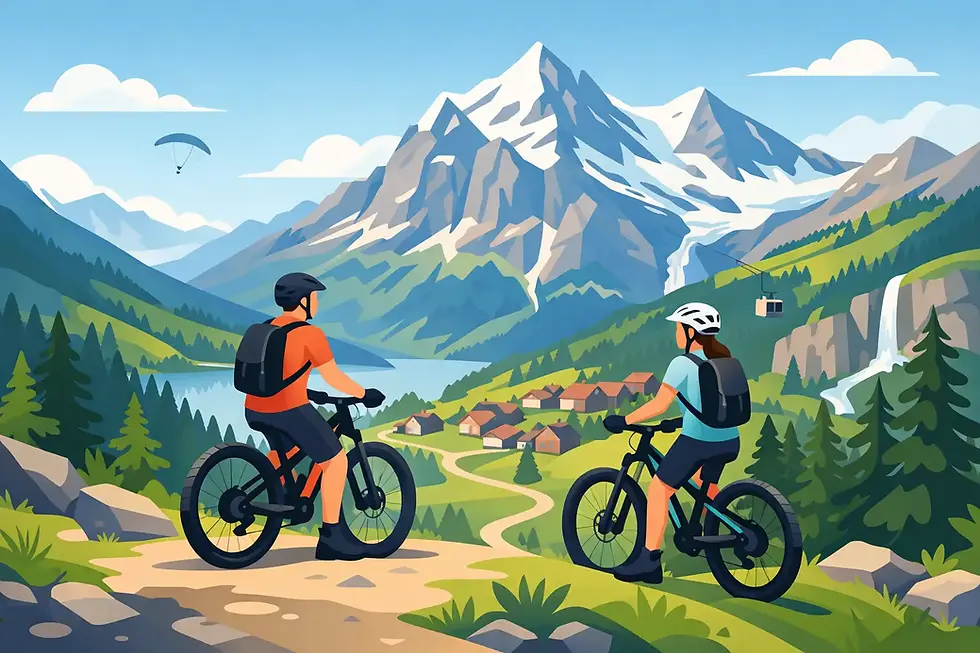
Here, a route is never only about kilometres or metres climbed. It might be an e-MTB morning past traditional farmhouses, a flowing singletrail afternoon beneath the Eiger, or a family ride that ends at a mountain restaurant before tired legs become unhappy legs. The Bernese Alps reward curiosity, but they also ask for sensible decisions.
Why local alpine route planning changes the whole experience
Grindelwald sits in dramatic terrain. That is exactly why it is such a memorable place to ride, and why generic route advice can fall short. A climb that feels manageable on an e-bike can become demanding in midday heat. A trail that suits confident mountain bikers may not be the right choice after overnight rain, when roots and stones are slick. A route that is peaceful in the morning can be busy later in the day with hikers, cows or holiday traffic.
Local knowledge puts these details together. It helps match the outing to the weather forecast, lift operating times, trail conditions, group energy and the experience you actually want to have. The best route is not automatically the hardest, longest or most photographed one. It is the one that leaves you smiling at the end of the day.
That matters especially when your holiday time is limited. Rather than spending hours comparing maps, wondering whether a route is suitable, or turning back after an unexpected section, you can spend the day riding through the landscape you came to see.
Start with the ride you want, not the route name
Before choosing a direction, think about the feeling you want from the day. Are you visiting as a couple and hoping for big views without an all-day endurance challenge? Are you a family looking for a safe, varied outing with plenty of stops? Are you experienced riders keen to find natural singletrail away from the most obvious visitor routes?
These choices shape everything. For first-time e-MTB riders, gentle forest roads and broad alpine tracks create room to settle into the bike, practise braking and enjoy the scenery. For fit, confident riders, a route can include more climbing, narrower trail and technical variation. For mixed groups, an e-bike route with flexible shortcuts often keeps everybody together without making the stronger riders feel held back.
There is no prize for selecting a route beyond your comfort zone. In alpine terrain, confidence is part of safety and part of enjoyment. A good plan gives you a challenge you can meet, rather than a challenge you have to endure.
Elevation matters more than distance
Ten kilometres in the valley and ten kilometres on a mountain road are entirely different rides. The gradient, altitude, surface and number of stops all affect how long a route takes. Even on an e-MTB, steep climbs use battery quickly if assistance is set high, tyres are soft or the rider is carrying a backpack all day.
A local guide plans with realistic timings rather than map timings alone. There may be a viewpoint worth reaching early, a shady climb that is more comfortable in warm weather, or a sensible place to pause for coffee and recharge people as well as bikes. These are the small decisions that make an outing feel relaxed rather than rushed.
Read the mountain, not only the forecast
Weather in Grindelwald can change quickly between valley floor and higher slopes. Sunshine in the village does not guarantee dry, warm conditions above the treeline. Cloud can close in, temperatures can drop and afternoon thunderstorms are a real consideration during summer.
Good route planning looks at the wider pattern, not just whether a weather app shows a sun symbol. Wind direction, recent rainfall, snow remaining on high sections and the timing of a storm all influence where it makes sense to ride. On some days, lower forest routes offer shelter and grip. On others, an early start opens up high alpine views before the heat or weather builds.
Trail surfaces deserve the same attention. Gravel tracks, compact farm roads, loose stones, wet roots and natural singletrail each require a different riding approach. Choosing a suitable surface helps beginners relax and lets experienced riders focus on the fun sections instead of dealing with avoidable surprises.
Respect shared paths and alpine life
The trails and access roads around Grindelwald are shared spaces. You may meet walkers, families, farmers moving livestock, service vehicles and other riders. A considered route includes places where riding is appropriate and considers how a group moves through the landscape.
Slow down when passing, greet people and give animals plenty of space. Cows can be unpredictable when protecting calves, while gates should always be left as they were found. These are simple habits, but they help preserve the warm welcome that makes mountain biking here possible.
Local alpine route planning also means knowing when not to take a trail. Seasonal restrictions, maintenance, muddy ground or unusually busy periods can make an alternative route the better choice. Flexibility is not a compromise. It is a sign that the day is being planned around good riding rather than a fixed line on a screen.
Build in the moments that make a holiday ride memorable
Some of the finest parts of a mountain bike day happen when the pedals stop turning. A wooden cheese hut high above the valley, a cold drink on a sunny terrace, the sound of cowbells across a meadow or the first clear view of the Eiger can become the memory people talk about long after the holiday.
That is why route planning should leave space. A tight itinerary can turn every photo stop into a delay. A well-paced route gives you time to look around, ask questions, adjust clothing and enjoy a proper lunch. For families, those pauses are often essential. For private groups, they create room for conversation and shared laughs instead of a constant race to the next junction.
The same principle applies to a Grindelwald-to-Lauterbrunnen outing. The route is not simply a way to connect two famous places. It is an opportunity to experience changing valleys, quieter backroads and the character of the Jungfrau region between the headline sights.
When a guided route makes sense
Independent riders can have excellent days here, particularly when they are comfortable reading alpine maps, assessing conditions and managing their own equipment. But a guided outing is valuable when you want the planning burden removed or when you want to see beyond the obvious routes.
A local guide can adapt the day as conditions change, choose a pace that suits the group and point out the places that visitors easily miss. That might mean avoiding a busy section, changing plans after rain, finding a scenic alternative for less confident riders or adding a short trail loop for stronger members of the group.
With Mountainbike Grindelwald, the focus is not on forcing every guest into one standard tour. It is on building a ride around your ability, interests and available time, whether that means a gentle discovery e-MTB experience, a more technical singletrail day or an active group outing with a mountain lunch.
A few practical details worth deciding early
The right bike is the foundation. An e-MTB can make long climbs and mixed-ability groups far more accessible, while a regular mountain bike may suit riders seeking a more physical challenge. Helmet fit, appropriate clothing, water and a small extra layer all matter more at altitude than many visitors expect.
It also helps to be honest about riding experience. Being active is not the same as being used to braking on loose gravel or descending a narrow trail. There is no judgement in starting on easier terrain. It gives you the chance to improve quickly and enjoy the views while doing it.
Finally, avoid treating the plan as fixed from breakfast until dinner. The mountain sets the conditions. A route that changes for the better because of weather, energy levels or a local tip is often the route you will remember most.
The finest rides in Grindelwald do not feel like logistics. They feel like a day that naturally unfolded through high meadows, forest tracks, village lanes and mountain views, with every turn arriving at the right time.


Comments